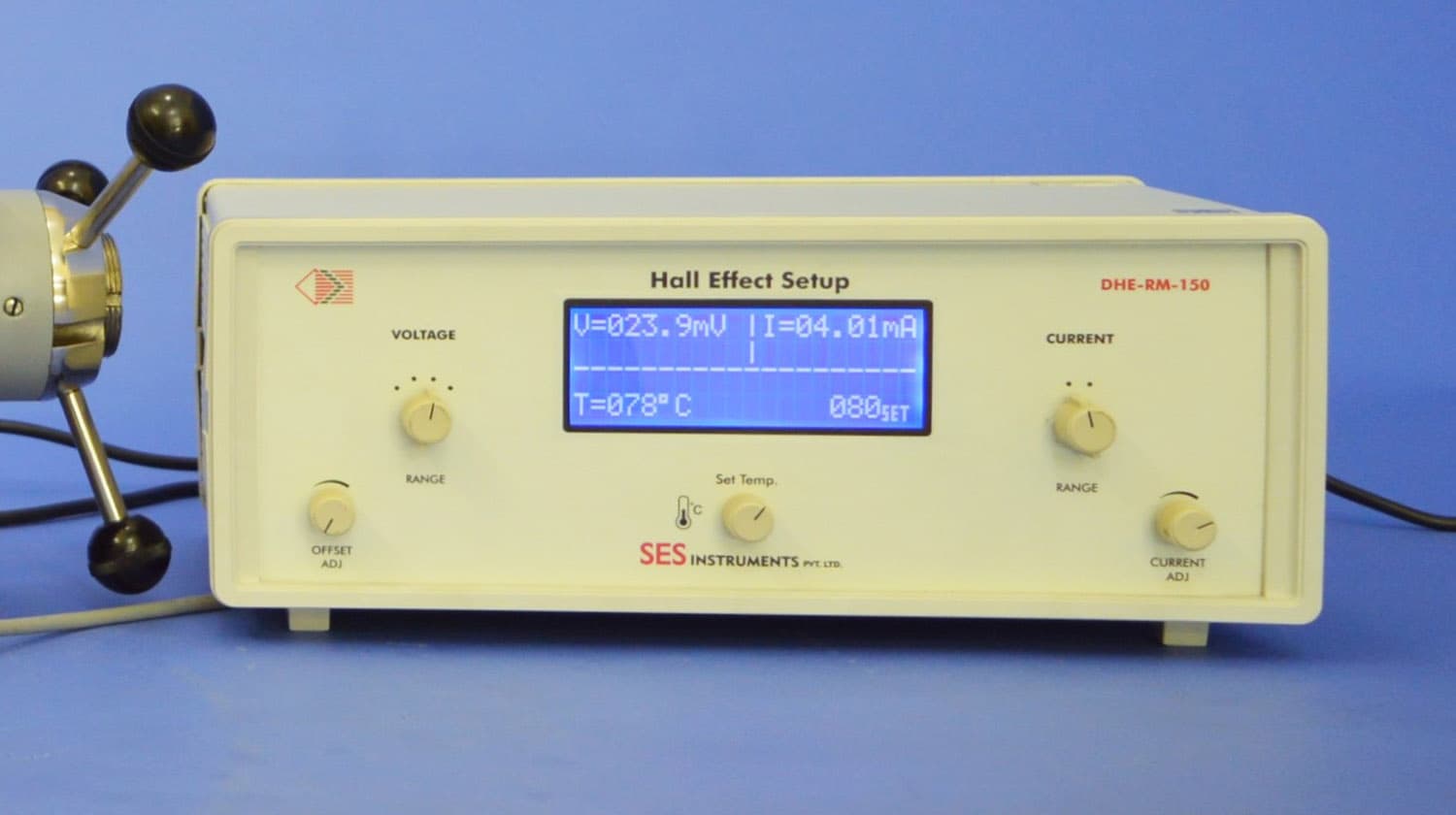
When a current-carrying conductor is placed in a magnetic field perpendicular to the current direction, a voltage develops transverse to the cuurent. This voltage was first observed in 1879 by Edwin Hall and the effect is called Hall Effect. The Hall effect has since led to a deeper understanding of the details of the conduction process. It can yield the density of the charge carriers as well as their sign. The hall voltage for p-carriers has opposite sign from that for n-carriers. Therefore if a semiconductor with p-type doping is gradually heated up, more and more electrons from its valence band will go to conduction band. As a result hall voltage would fall rapidly with temperature and even become zero or change sign.
Specifications
Technical data
Model
HEX-RM-150/HEX-RM-150C
Manufacturer
SVS Labs
Material
Ge single crystal n-type & p-type
Resistivity
8-10W.cm
Zero- Field potential
<1mV (adjustable)
Hall Voltage
25-35mV/10mA/KG
Zero-field potential
<1mV (adjustable)
Range
1mV, 10mV, 100mV, 1V
Resolution
1 mV
Accuracy
±0.2% ±1 digit
Stability
Within ±1 digit
Applications
Used in physics and electronics laboratories for hall effect experiment-related experiments.
Suitable for undergraduate teaching, postgraduate coursework, and research projects.
Compact bench-top design fits standard laboratory benches and demonstration setups.
Features
Hall Effect Experiment (Research Model)
Quick inquiry
Lock in a quote for Hall Effect Experiment (HEX-RM-150/ HEX-RM-150C).
Fill the form — we’ll respond with a proforma invoice, INCOTERMS variations and lead-time within one business day.