Measurement of Magnetoresistance in Different Samples (MRX-RMC)
MEASUREMENT OF MAGNETORESISTANCE OF WIDE VARIETY OF SAMPLES Description, Here the above referred symbols are defines as: v = drift velocity, E = applied electric field.
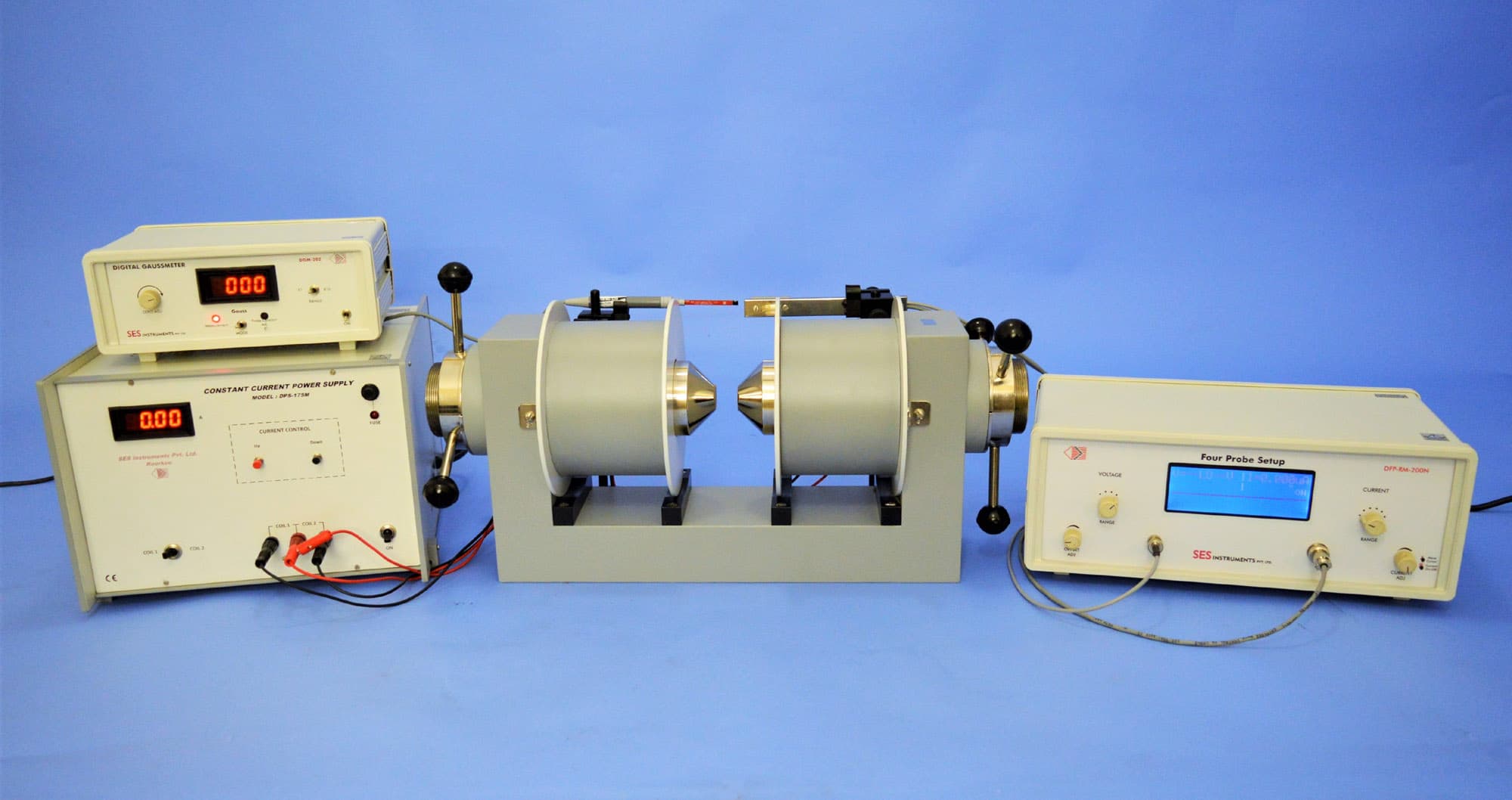
It is noticed that the resistance of the sample changes when the magnetic field is turned on. The phenomenon, called magnetoresistance, is due to the fact that the drift velocity of all carriers is not same. With the magnetic field on; the Hall voltage V=Eyt=|v x H| compensates exactly the Lorentz force for carriers with the average velocity; slower carriers will be over compensated and faster one under compensated, resulting in trajectories that are not along the applied field. This results in an effective decrease of the mean free path and hence an increase in resistivity. Here the above referred symbols are defines as: v = drift velocity Description of Experimental Set-up 1.
Technical data
- Model
- MRX-RMC
- Manufacturer
- SVS Labs
- Ge Crystal (n-type) dimensions
- 10 x 10 x 0.5mm.
- Used in physics and electronics laboratories for measurement of magnetoresistance in different samples-related experiments.
- Suitable for undergraduate teaching, postgraduate coursework, and research projects.
- Compact bench-top design fits standard laboratory benches and demonstration setups.
- MEASUREMENT OF MAGNETORESISTANCE OF WIDE VARIETY OF SAMPLES Description
- Here the above referred symbols are defines as: v = drift velocity
- E = applied electric field
Lock in a quote for Measurement of Magnetoresistance in Different Samples (MRX-RMC).
Fill the form — we’ll respond with a proforma invoice, INCOTERMS variations and lead-time within one business day.